
Around that time, a teacher in primary school decided to weigh us all as part of our maths syllabus. I remember standing on the scales and the teacher looking at me after reading the number on the scales shaking her head and saying, “it’s hard Clare isn’t it?”.
And so it began, an early introduction to body shaming and a stormy tumultuous relationship with food that has lasted for over forty years. Other memories flood back as I write this - the 6th class girls in school striding into the classroom one day and one of them saying “Claire why do you never wear jeans?” And another answering on my behalf “It’s because she’s too fat”. After this I would eye up the dusty weighing scales that sat underneath the bookshelves at school and dread the moment it might be used again. I would feign illness when I thought weight was going to be coming up again in Maths because I did not want to be weighed again and to be made fun of. During one of these periods of pretending to be unwell with a stomach-ache, the doctor came into my bedroom to examine me and said to my mother “do you think it might be psychological?”. “Not at all” she replied and little did she know how right the doctor was at the time.
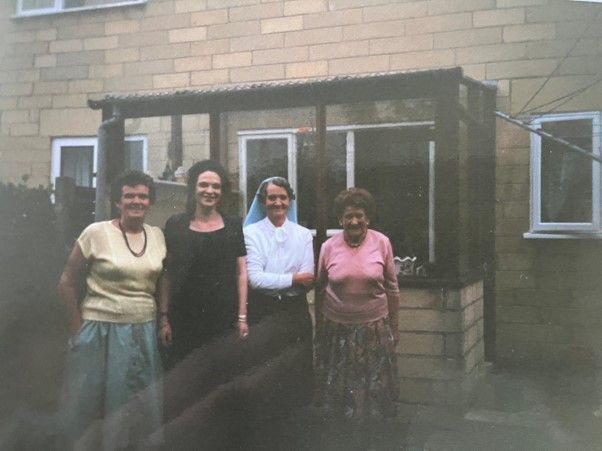
As a child I would eat normally during the day but at night I would sneak downstairs to the kitchen and make myself two rounds of cheese sandwiches and eat them in bed while reading. I have no recollection of how I managed to sneak down into the kitchen and prepare this food for myself unbeknown to my parents. But I do remember my aunt, a nun, was visiting from South Africa. She loved cleaning and she had her work cut out for her at our house -my mother hated housework and cooking! My aunt came into my room one day all set for a deep clean although we didn’t call it that at the time! She peered under my bed and spotted a plate of cheese sandwiches gathering dust and said, “Claire you know gluttony is a sin”. Small things that happened you might say, but I collected all these experiences together to use as little sets of evidence that a) I was fat – well I must be if my Dad had said I was because he knew everything, and b) I was different and c) eating was a sin. I look back on that young girl now and realise she was minding herself in the only way she knew how. There must have been something about the nighttime that made me uncomfortable. I was entirely self-sufficient, but I must have been very lonely. Geneen Roth writes that compulsive eating is "a way we leave ourselves when life gets hard." I think many of us can identify with this statement whether our substance of choice was or is alcohol, drugs, food, gambling, or something else. The addiction may vary for each of us, but the impulse is often the same: to leave ourselves, to leave the present moment, to leave uncomfortable feelings and I have left myself so many times. If there is something going on in my life, I no longer self soothe with alcohol, but I either deprive or comfort myself with food. And it has to be eaten while watching television or reading. That hand to mouth action is vital in times of stress or sadness.
My father visited us in Ireland nearly twenty years ago - he had cycled all the way from Berkshire to West Clare. I remember waking up on the first morning of his stay and seeing M & M’s all over the kitchen counter and several jars and packets of food opened and it looked like they had been hastily put back in the cupboard. When my father got up that morning he said “You’ve got too much food in your cupboards” – and I felt shame again – and this was in my thirties.
As a teenager I hated my thighs – if I could have physically detached them from my body I would have and I would get up early to run and try to lose weight. There was a wealth of material available to me at home to educate myself about calories- a book called How to be Lean, various calorie counting books, and I approached my new project – changing from a fat Claire into a thin Claire with all the zealousness of someone newly converted. Around this time my Dad went to Weight Watchers and lost a lot of weight, he would weigh out his food on a little weighing scale in the kitchen. Then there was the time my mother came home from town with a Dunnes Stores bag with some mint green summer trousers in it. They didn’t fit her and she remained quiet and withdrawn for the rest of the day.
When my family and I moved to the UK at 17, food suddenly became a way of controlling what was going on around me. I couldn’t control the fact that I had been catapulted into a strange country where nobody sounded like me, so I started binging and depriving myself of food. A few years later I discovered the book by Rosemary Conely – The Hip and Thigh Diet - and I lost a significant amount of weight, I was delighted with myself - that’s it - job done, and I went back to eating normally and of course the weight piled back on. My mother went on the same diet and lost a lot of weight. I stared at her miserably as she ate yogurt feeling the rolls of fat digging into the waistband of my trousers.
“Nothing tastes as good as skinny feels”, the model Kate Moss proclaimed controversially a few years ago, but nothing was quite as good as getting on the scales and weighing myself and seeing the number gradually descending to the left on the scales.
And now? When I stopped drinking three years ago, I was damn glad that one of the much lauded about consequences would be weight loss. And I kept waiting for the pounds to disappear. They didn’t! I survived that first year by eating lots of Haribo but also perhaps eating normally for the first time ever in my life. Towards the end of my drinking, I had stopped eating, simply because it got in the way of drinking. I didn’t want anything interfering with that numbing out, that escaping, that short time where I didn’t really have to think about anything. The weight did eventually start to shift but slowly. I will probably always have a rocky relationship with food. For so long it has been a barometer of how I am feeling. If something happens to upset me or I feel angry, I can literally feel the door closing down on my appetite.
On Sunday my husband took me my son, my mother-in-law and sister-in-law out for lunch to a local hotel. They have a carvery there on a Sunday and my husband absolutely loves it. I detest it. For those of you who may not know what an Irish carvery is , it’s a meal usually involved roast meat served along with vegetables and potatoes from Bain Maries from a hot food counter. I didn’t want the dinner, so I went straight to dessert and had lemon meringue pie. But I grazed for the rest of the day, popcorn, sweets, chocolate and biscuits and finally went to bed telling myself I would have to eat properly tomorrow. Looking back and reflecting, I try to bypass the despair that I feel around my complicated food relationship and try and figure out what was going on. The truth was I had just been through a colonoscopy where I hadn’t been allowed to eat anything for 48 hours, then I had spent two days supporting my family through the sudden loss of my husband’s uncle. In retrospect, the Sunday eating was an attempt by me to have time out and to leave myself again.
Now the drink has gone, there are less places to hide but I continue to hide behind food. I guess something you’ve been doing since you were a child is a hard pattern to change. People talk about cross addiction…. I can’t give up food - if I did I would die, but my brushes with both anorexia and bulimia have left an indelible mark on me.
I haven’t weighed myself for years. My husband keeps a weighing scale at the back of his wardrobe hidden because he knows that I have always said I can’t have one in the house. Recently while in hospital, I was weighed by the nurse as I was admitted and for the first time ever, I looked down at the scales to read what it said – 70 kilos. It felt like a life changing moment for me. I look back on photos of myself big, small and medium sized and feel only sadness. I have abused this poor body of mine for a long time.
And so it began, an early introduction to body shaming and a stormy tumultuous relationship with food that has lasted for over forty years.
I bring you this very personal story to throw some light on it and take it out of the dark corner of my mind and my heart where it has hidden for so long. Perhaps there is something here that resonates with you. I am a living breathing human who lives a good life, a sober life but I still make mistakes in learning how to take care of myself – as I did on Sunday. I know I must be mindful of my relationship with food because it can take over and become the focus of everything I am doing wrong. I would encourage you to check out Geneen Roth’s work. She has a new book coming out: “Love, finally – untangling the knot between mother’s daughters and food”. I look forward to reading it and gaining further understanding and insight into my own thorny prickly relationship with the substance that we all need to simply keep us alive.
xxxx

info@tabbforwomen.com
© 2025 - 2025 All rights reserved
Find My Best Starting Point
Every woman's journey is different. Let's discover what will support you best.
Answer 8 simple questions and we'll recommend the TABB pathway that's the best fit for where you are right now.
There are no right or wrong answers—just answer honestly.
It only takes around 2 minutes.
1. Where are you right now on your alcohol-free journey?
A. I'm happily alcohol-free and want to stay that way. B. I've stopped recently but I'm finding it harder than I expected. C. I'm still drinking and know something needs to change. D. I'm not sure if I even want to stop yet—I just know I need to explore my relationship with alcohol.
2. What kind of support sounds most helpful?
A. Being part of a supportive community of women who understand. B. A structured programme I can work through in my own time. C. One-to-one conversations with someone who can guide me personally. D. A combination of structure and personal support.
3. Which statement sounds most like you?
A. I already know I want an alcohol-free life. B. I keep trying to stop but never seem to make it stick. C. I need help taking the very first step. D. I want someone to keep me accountable.
4. How important is connecting with other women?
A. It's exactly what I'm looking for. B. I'd like some connection alongside a course. C. I'm not sure yet. D. I'd rather keep things private.
5. What describes you best?
A. I often feel isolated or lonely. B. I feel overwhelmed and don't know where to start. C. I need structure to help me stay focused over time. D. I know what I need—I just want personalised support.
6. Which of these sounds most appealing?
A. Daily meetings and ongoing support from a community. B. A self-paced programme that I can complete around my life. C. Regular one-to-one coaching sessions. D. Daily check-ins with someone who's walked the same path.
7. If you could wave a magic wand, what would change?
A. I'd finally stop drinking. B. I'd stay stopped this time. C. I'd feel connected instead of doing this alone. D. I'd have someone helping me every step of the way.
8. Which best describes your personality?
A. I thrive in a supportive group. B. I like learning independently. C. I work best with one dedicated person supporting me. D. I like a mixture of independence and accountability.
Your TABB recommendation is ready
Enter your email address to discover the TABB support that best matches where you are today.